
Your heart’s racing. Your thoughts won’t stop. You feel like your brain is going a mile a minute—and you’re supposed to go to work or make dinner like nothing’s wrong?
If your anxiety feels like it hijacks your brain without warning, you’re not broken. You’re human. And the good news? You don’t have to stay stuck in that mental tornado.
This article gives you quick, effective tools to use when your anxiety feels overwhelming. We’re talking grounding skills, mindfulness you can actually use, and DBT-inspired techniques that don’t require a therapist in the room.
Let’s get you some calm, fast.
What’s Actually Happening in Your Body & Brain
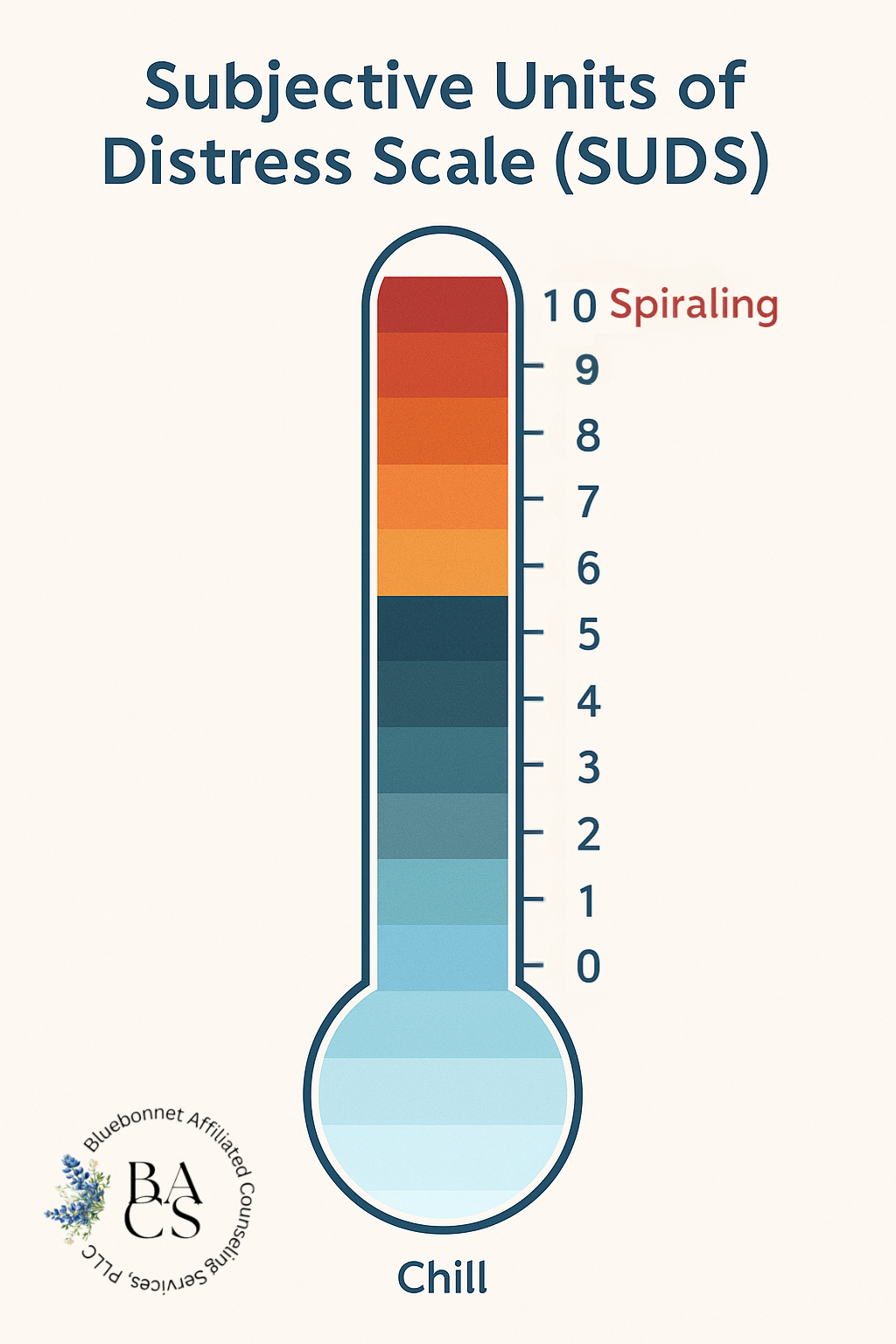
Anxiety isn’t just “in your head.” It’s a full-body experience. When you’re anxious, your brain activates the fight-flight-freeze response, pumping adrenaline, speeding up your heart rate, tightening your muscles, and basically screaming, “Danger ahead!” even when no tiger is chasing you.
One helpful way to tune into this is with a SUDS Thermometer—SUDS stands for Subjective Units of Distress Scale. Think of it like a thermometer for your stress and anxiety. Zero means you’re totally chill, ten means you’re absolutely panicking.
By asking yourself, “Where am I on the SUDS scale right now?”—you start developing body awareness. You might notice you clench your jaw around a 6, your chest tightens around an 8, or you dissociate around a 9. That awareness helps you act before things boil over.
Understanding the mind-body connection is key—and it’s the first step to interrupting that anxiety spiral.
Grounding Skills: Get Out of Your Head and Into the Now
When anxiety floods your system, you need something that snaps you out of the thought loop and back into your body. That’s where grounding skills come in.
Grounding techniques help disrupt anxious spirals by focusing your attention on the physical world around you—what you can see, feel, hear, smell, and taste. These sensory cues help bring you out of your thoughts and into the present moment, where your body can begin to regulate again.
These are simple techniques that use your senses to pull you back to the present moment:
- 5-4-3-2-1 Technique: Name 5 things you see, 4 you can touch, 3 you hear, 2 you smell, and 1 you taste.
- Cold water splash or ice cube hold: A quick jolt to the system that brings you back into the now.
- Name items by category: Pick a category like animals, colors, or TV shows and name as many as you can.
Grounding is like grabbing an emotional anchor when your brain is drifting off into a storm.
Mindfulness That Doesn’t Feel Woo-Woo
Mindfulness is just a fancy word for paying attention on purpose. It doesn’t mean you have to sit cross-legged and hum. It means noticing what’s happening right now—and not judging it. For people with anxiety, mindfulness can be especially powerful because it teaches the brain to pause, observe, and respond rather than react impulsively. It helps you see the storm without getting swept up in it.
When anxiety ramps up, mindfulness helps you pause and observe instead of reacting. It can be simple:
- Box Breathing: Inhale for 4, hold for 4, exhale for 4, hold for 4. Repeat a few rounds.
- Thoughts as Clouds: Picture your thoughts floating by like clouds—no need to chase or fight them.
- Name it to tame it: Say out loud (or internally), “I’m feeling anxious,” or “I notice fear.” This helps your brain regulate emotion by labeling it.
Mindfulness puts a little distance between you and the panic. And the more you practice it—even for a minute or two a day—the easier it becomes to access in the heat of the moment.
DBT-Inspired Coping Skills: When It’s Big and Loud and Messy
DBT (Dialectical Behavior Therapy) is a therapy approach full of practical, no-nonsense tools that help when your emotions feel way too big.
These skills are especially useful when you feel like you’re drowning in emotion and logic has left the building. DBT teaches that your emotions make sense—but you don’t have to let them run the show.
One of the most powerful DBT skills for anxiety is TIPP:
- T – Temperature change: Splash cold water on your face, hold an ice pack, or take a cold shower.
- I – Intense exercise: doing some jumping jacks or going for a quick jog can help burn off that anxious energy.
- P – Paced breathing: Try slow, controlled breathing (like box breathing above).
- P – Progressive Muscle Relaxation (PMR): Tense and release muscle groups to reset your body. You can check out a PMR exercise I created here or feel free to peruse YouTube for others that work best for you by looking up “Progressive Muscle Relaxation Exercises”.
Other helpful DBT skills:
- Self-Soothing with the Senses: Light a calming candle, listen to music, wrap up in a blanket. Comfort yourself on purpose.
- Opposite Action: Anxiety says isolate? Send a text. Anxiety says stay frozen? Take one small action step.
These skills help you ride out intense emotions without letting them steer the ship. They give you a playbook when everything feels like it’s falling apart.
What to Remember When Nothing Feels Like It’s Working
Some days, the tools won’t work like magic. That doesn’t mean you’re failing. It means your nervous system might need more time, more practice, or more support.
Healing isn’t linear. It’s messy, frustrating, and sometimes the most powerful thing you can do is just not give up. When the panic keeps coming, when the tears won’t stop, when you feel like nothing helps—know that this isn’t the end of the story. You are doing something brave just by noticing and trying. You don’t have to win every battle to be making progress. It’s okay to rest. It’s okay to ask for help. These quick techniques are tools, not instant cures. The more you use them, the more effective they become. And if things feel too big to manage on your own, that’s not weakness—that’s a cue to get support.
You’re not supposed to do this all alone.
Wrapping It Up
You don’t have to outthink your anxiety—you can outskill it.
These tools won’t fix everything overnight, but they’re powerful ways to reclaim calm, reconnect with your body, and give yourself the care you need in the middle of the storm. If you’ve tried managing anxiety alone and feel like you’re still drowning, you don’t have to keep going solo. Support exists, and you deserve access to it. If you’re ready to learn more tools like this—or want a guide to help walk you through the mess—reach out. Therapy is a great place to build this skillset.
You deserve peace, not just panic management.